Integrations: connected through NexHealth (server)
Automated insurance verification for OrthoTrac
Ardent works alongside OrthoTrac through the NexHealth Synchronizer installed on your OrthoTrac server. It reads upcoming appointments and each patient’s insurance on file, verifies benefits with the payer, portal first and a phone call for what is left open, then fills your own breakdown sheet, ortho block included, and files the PDF into the patient’s documents before the visit.
- Connected through NexHealth’s server path: the Synchronizer is installed on your OrthoTrac server by a NexHealth engineer at a scheduled time. It is not a direct OrthoTrac integration.
- Reads the schedule, patient details and the insurance coverage on file; never writes into OrthoTrac’s coverage tables.
- Files the finished sheet as a PDF in the patient’s documents, once per appointment.
- No appointment note on OrthoTrac: NexHealth does not support a note update there, so failure reasons go to the 7:00 AM email and the Ardent app.
How it works
How does Ardent work with OrthoTrac?
NexHealth’s Synchronizer reads your OrthoTrac schedule and the insurance record on each patient. For each visit inside the window, Ardent checks the payer: the provider portal first, or EDI 270/271 or a faxback where that is the payer’s channel, then an AI phone call for required blanks still open. It draws the answers onto your sheet and files the PDF through NexHealth into the patient’s documents.
What Ardent reads from OrthoTrac
- Upcoming appointments: time, provider, operatory, confirmed / cancelled / no-show flags, and the appointment note.
- The patient: name, date of birth, patient ID.
- The insurance coverage on file: carrier and plan, subscriber ID, relationship to the subscriber, effective and expiration dates, group number, employer, and the payer ID Ardent uses to pick the payer’s playbook.
- Chart history where OrthoTrac exposes it, used to answer the office’s own questions, never a payer’s.
What Ardent writes back to OrthoTrac
| Artifact | Written? | Where and when |
|---|---|---|
| Chart document (PDF) | Yes | The patient’s documents, under the document type your office chooses. Named insurance-eligibility-<first>-<last>.pdf; filed once per appointment after a successful check inside the window. |
| Appointment note | No | NexHealth supports a note update only on Dentrix, Dentrix Enterprise, Eaglesoft and Open Dental; elsewhere the next sync would put the old note back, so Ardent does not write one. Reasons appear in the 7:00 AM email and in the app. |
| Coverage-table fields | No | Never. Plan entry in OrthoTrac stays with the office, done from the filled sheet in the chart. |
Swipe to see the whole table →
The PDF holds the completed sheet page or pages, then the payer’s own documents the portal preserved, any received fax, and the portal screenshots Ardent kept, tiled to letter pages. The REP blank reads Ardent on an unattended upload; the date is the day the check finished.
Setup
How the connection works
OrthoTrac is a server-based PMS, so the NexHealth Synchronizer is installed on the server that runs it. NexHealth lists OrthoTrac among the on-premise systems its own team installs rather than a self-serve installer: your office submits server credentials and picks an installation time with a NexHealth engineer. NexHealth then grants Ardent access to your practice’s schedule, patients and insurance records. Ardent itself never signs into OrthoTrac.
- Connect. The Synchronizer goes on the OrthoTrac server, installed by NexHealth’s engineer at the time your office schedules; NexHealth’s published server requirements are Windows 10 or Windows Server 2012 R2 or later. NexHealth’s statement on cost: "Practices don’t pay for the Synchronizer. There’s no setup fee, no subscription." (nexhealth.com; confirm current terms with NexHealth.)
- Baseline. Ardent pulls every future appointment once and checks counts, dates, patient matching, coverage data and payer mapping with your office.
- Choose the sheet and the document type. Your breakdown sheet is measured once; the document type that should receive the PDF is set on the connection.
- Switch on, one flag at a time. Hourly polling, then the 6:00 AM ahead-of-visit run, then the 7:00 AM digest, then automatic filing, each after a supervised first run. Automatic filing stays off until a test PDF has reached the intended chart and document category.
We do not promise a go-live date. NexHealth publishes no installation time for its server-based installs; its "up to 72 business hours" figure is for cloud systems and does not apply to OrthoTrac.
One patient, next week
The sheet, filled.
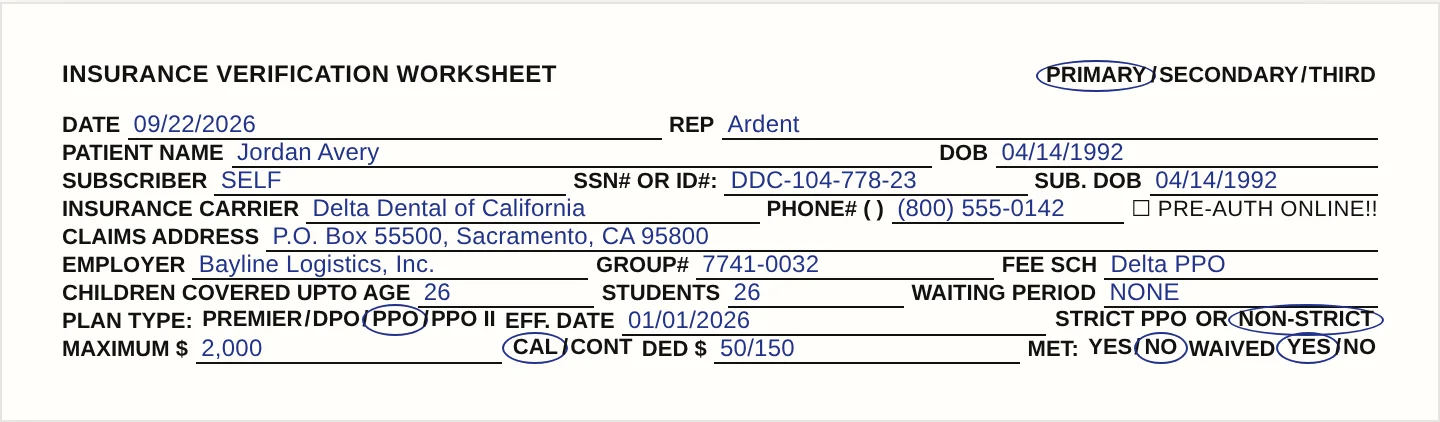
Filed into OrthoTrac as a chart document. Sample data, fictional patient. Watch the full sheet fill in on the home page →
Orthodontic benefits
What the sheet holds for ortho
The general worksheet carries an ortho block, and Ardent fills it like every other block, only from what the payer stated: ortho maximum and remaining, ortho deductible, adult and child age limits, whether the plan pays automatically, monthly or quarterly, the D8090 percentage, waiting period and ortho history. A blank the payer would not state stays blank; a stated exclusion prints NC.
If your office uses its own breakdown sheet, that sheet is measured once and filled instead.
The exceptions
What still needs a person
Anything Ardent could not verify. Every weekday at 7:00 AM your front desk gets one email, with the subject [Ardent Dental] <Office> Insurance Eligibility for <Weekday, Month D>. It lists each appointment Ardent could not verify and why, in plain words: a member ID missing, a plan that ended, a payer Ardent cannot check yet. On OrthoTrac that email and the app carry the reasons; there is no appointment note.
A required blank the payer would not state stays blank on the sheet, the appointment is flagged "Someone has to call," and it is in that morning’s email. When every appointment verified, the email says so in one line.
Answers
OrthoTrac insurance verification FAQ
No. Ardent files the completed sheet as a PDF in the patient’s documents. It never edits insurance plans, coverage tables or fee schedules in OrthoTrac, and on OrthoTrac it does not write an appointment note either. Plan entry in the software stays with the office, done from the filled sheet in the chart.
In the patient’s documents, under the document type your office sets on the connection. NexHealth supports writing a PDF into OrthoTrac but publishes no default folder for it, so the destination is confirmed with a test PDF before automatic filing is switched on. The file is named insurance-eligibility-<first>-<last>.pdf, shows REP "Ardent" and the date the check finished, and is filed once per appointment; a chart keeps every filed check.
No Ardent user in OrthoTrac. NexHealth installs its Synchronizer on the OrthoTrac server with credentials your office provides for the scheduled install, and NexHealth grants Ardent access to your practice’s data. Ardent never signs into OrthoTrac; it reads and files through NexHealth. Ardent’s own users are your staff, on your practice’s email domain.
Because NexHealth supports updating an appointment’s note only on Dentrix, Dentrix Enterprise, Eaglesoft and Open Dental. On OrthoTrac the next sync would restore the old note, so Ardent does not write one. Every failure reason still reaches you: in the 7:00 AM email and on the appointment card in the Ardent app.
It fills the ortho block on your sheet from what the payer states: ortho maximum and remaining, deductible, adult and child age limits, how the plan pays (automatically, monthly or quarterly), the D8090 percentage, waiting period and history. What the portal does not state, the phone call asks. A blank nobody stated stays blank; NC prints only for a stated exclusion.
By a NexHealth engineer, at a time your office schedules, using server credentials you submit in advance; NexHealth offers no self-serve installer for OrthoTrac and publishes no installation time for it. After that, Ardent runs a baseline pull with your office and switches on polling, the ahead-of-visit run, the digest and filing one at a time. We do not publish a go-live date.
The appointment is set to "Needs info" instead of guessed at, the reason appears in the 7:00 AM email and on the appointment card in the app with a "Fix & re-run" button. Once the front desk corrects the record in OrthoTrac, the next check runs from the corrected details.