Worksheets: three free PDFs
Dental insurance verification worksheets, free to print
The breakdown sheet is where a verification ends: one page, filled by hand from the payer’s portal and a phone call, in the shorthand the whole office reads. These are three of them, blank and printable, for a general practice, a pediatric office and an orthodontic office. Below them, how to fill one in and what to ask the payer.
- Three one-page, letter-size PDFs: general, pediatric and orthodontic. Free to download, print and use.
- Blanks sized for handwriting, with the circle-one choices and shorthand a coordinator already uses.
- A step-by-step for filling one in, and the questions each block of the sheet is really asking.
- Ardent fills any of these, or your own sheet, before the visit.
Three sheets
Which worksheet fits your office?
Every office fills a different sheet, so there are three. Each is a single letter-size page, printable, with blanks sized for handwriting and the shorthand a coordinator already uses: 2xC/Y, 1x36m, NL, NC. They are free to download, print and use in your practice. The general worksheet is the same form the fictional patient on the home page is filled onto; the pediatric and orthodontic sheets add the rows those offices verify.
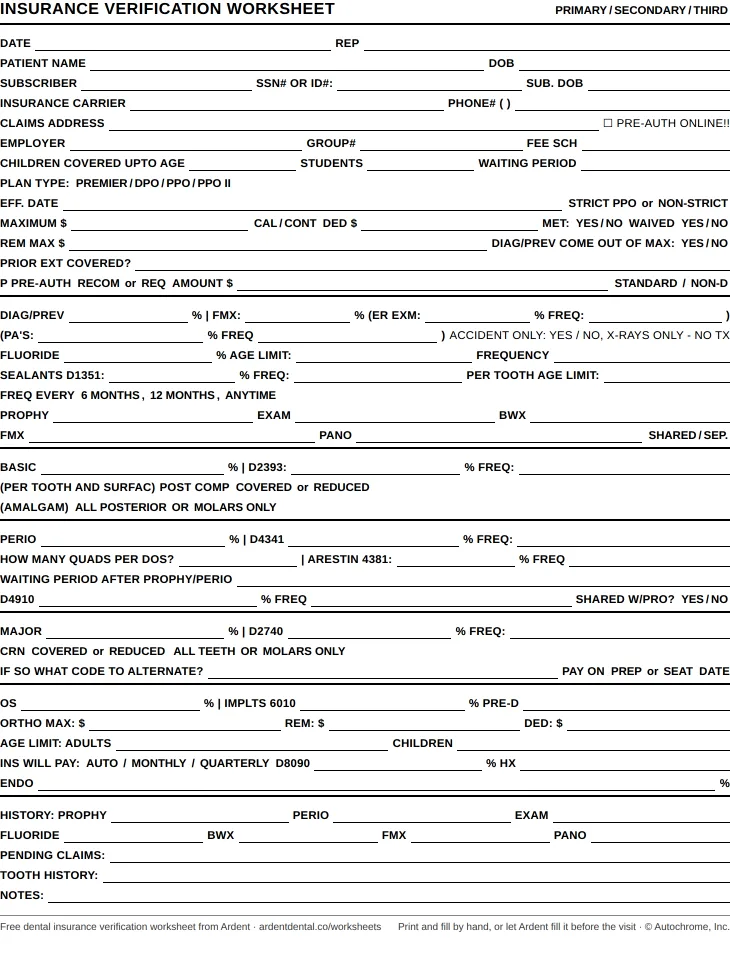
General insurance verification worksheet
The full breakdown a general practice asks for: plan and subscriber details, maximum and deductible, diagnostic and preventive frequencies, basic, perio, major, oral surgery, endo and ortho percentages with their frequency limits, history dates, pending claims and notes.
Download the PDF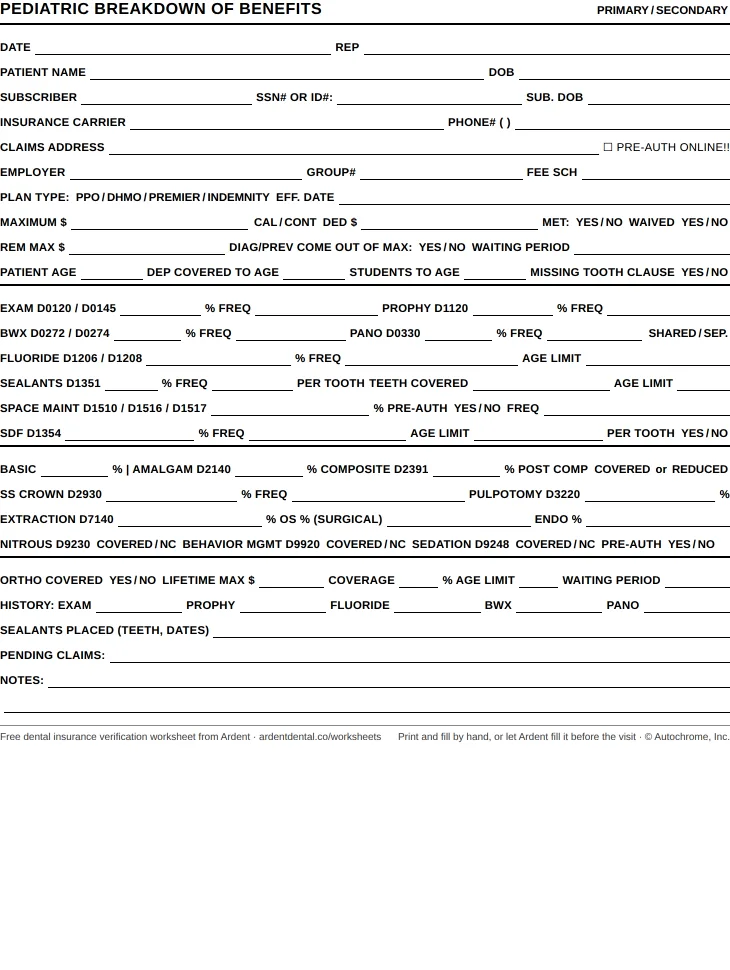
Pediatric breakdown of benefits
What a pediatric office asks that a general sheet never lists: dependent and student age limits, fluoride and sealant age limits with the teeth a sealant covers, space maintainers, silver diamine fluoride, stainless steel crowns, pulpotomies, nitrous, behavior management and sedation, plus the ortho block.
Download the PDF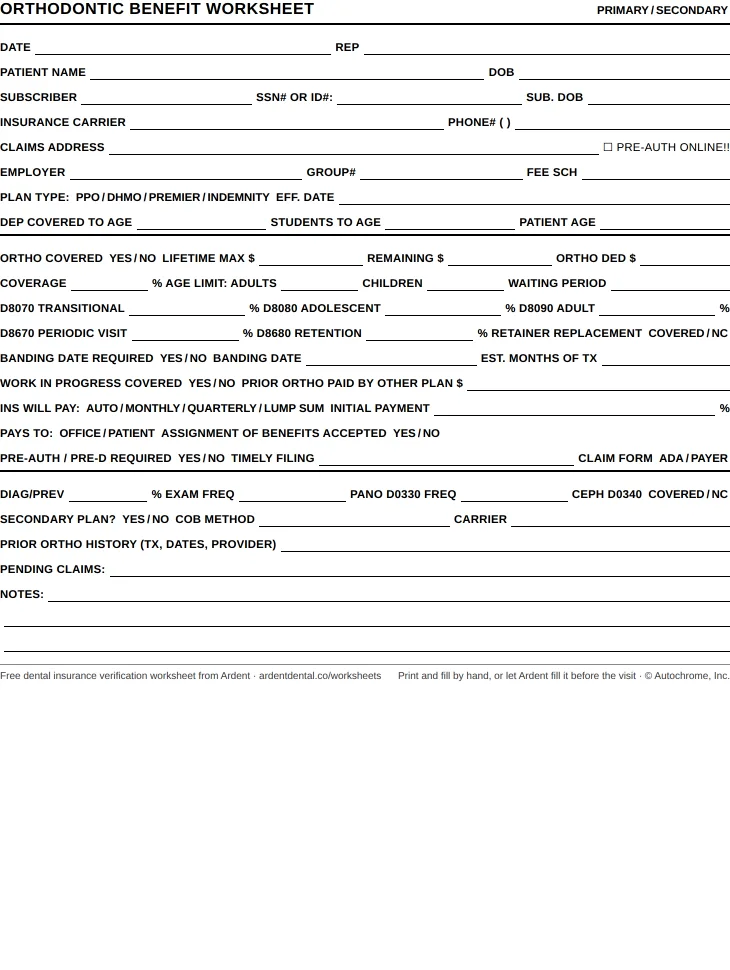
Orthodontic benefit worksheet
What an orthodontic office verifies: the lifetime maximum and what remains, coverage by CDT code, age limits, waiting period, banding date rules, work in progress, how and to whom the plan pays, pre-determination, timely filing and coordination with a second plan.
Download the PDF
How to use it
How to fill in a dental insurance verification worksheet
The sheet is filled in the order a coordinator reads it, from the plan and subscriber details at the top to the history dates and notes at the bottom, and every value is written in the office’s own shorthand. Verify early enough to fix inactive coverage or a missing member ID, and late enough that the benefits used are current; a week ahead is a common target.
- Pull the schedule. Work from the appointments a week out, and start each sheet from the insurance on file: carrier, member ID, subscriber and group.
- Portal first. Sign into the payer’s provider portal and read the benefit grid field by field. Save or print the benefits summary; it is the source behind every value.
- Phone for the rest. Call the provider line only for the blanks the portal left open, typically frequency details, waiting periods and clauses. Write down the rep’s name and the reference number.
- Write in your shorthand. Percentages, frequencies (2xC/Y, 1x36m, 1x60m/tooth), age limits, NL for no limit, NC for not covered. Leave a blank empty if nobody stated it; never guess.
- File it. Scan or save the finished sheet into the patient’s chart documents, note anything that needs fixing on the appointment, and tell the front desk about the exceptions.
What to ask
What questions should you ask when verifying dental insurance?
The worksheet is the checklist. Read down it and every blank is a question for the portal or the rep. Grouped, they are:
- The plan. Is the patient active today, and since when? Which plan type and fee schedule? Calendar or contract year? Dependents covered to what age, and students?
- The money. Annual maximum and what remains. Deductible per person and per family, whether it has been met, and whether preventive care is waived from it. Do diagnostic and preventive services count against the maximum?
- The percentages. Diagnostic and preventive, basic, periodontal, major, oral surgery, endodontic and orthodontic, and which procedures the plan puts in each category.
- The frequencies and dates. Exams, prophylaxis, bitewings, full mouth series and panoramic film (shared or separate), fluoride and sealants with their age limits, perio maintenance, crowns per tooth, and the date each was last paid.
- The clauses. Waiting periods by category. The missing tooth clause. Downgrades on posterior composites and crown materials, and which code the plan alternates to. Quadrants of scaling per day. Pre-authorization thresholds.
- The claim. Claims address or payer ID, timely filing, and, for ortho, how the plan pays out and whether it pays the office.
Or let Ardent fill it
The sheet you already use, filled before the visit
Ardent fills whatever sheet your office already uses, including these. It reads the schedule from your practice management system, verifies each patient with the payer, portal first and a recorded call for what is left, types the answers into your blanks in your notation, and files the PDF into the patient’s chart up to two weeks before the visit. A blank nobody stated stays blank, every value keeps its source, and one weekday email tells your front desk about anything that needs a person.
Watch the general worksheet fill in Your own form, measured once
Answers
Worksheet questions
Yes. Download, print and use them in your practice, and adapt them however you like. They are the sheets a general, pediatric and orthodontic office fills in by hand, not a product form, and there is nothing to sign up for.
The general worksheet covers the full breakdown for an adult practice, by category and code. The pediatric breakdown adds dependent and student age limits, fluoride and sealant age limits with the teeth a sealant covers, space maintainers, silver diamine fluoride, stainless steel crowns, pulpotomies, nitrous, behavior management and sedation. The orthodontic worksheet is built around the lifetime maximum, coverage by ortho code, banding date rules, work in progress, how the plan pays out and coordination with a second plan.
The shorthand coordinators write on a breakdown sheet. 2xC/Y is twice per calendar year; 1x36m is once every 36 months; 1x60m/tooth is once every 60 months per tooth; NL is no limit; NC is not covered. Write whatever shorthand your team already reads.
Early enough to fix inactive coverage or missing details, and late enough that benefits used are current. Many offices work about a week ahead; Ardent’s default is five business days, reaching up to two weeks, and a successful check within 30 days of the appointment is reused.
Yes. Ardent stores your sheet’s PDF and draws the answers onto it, blank by blank, in your notation. A new sheet is set up by measuring its blanks once. A general worksheet and a pediatric breakdown are in production today, and an orthodontic sheet is set up the same way.