Dental insurance verification, filled into your sheet and filed in your PMS before the patient sits down.

- Payers supported
- 71 payerseach with its own playbook: Delta Dental, MetLife, Cigna, Aetna, Guardian, etc.
- Time saved
- 40 hours a weeksaved at the front desk, on portal logins, hold music and retyping
- Field accuracy
- 99.8% accurateon the fields Ardent fills, each one carrying the payer record it came from














What is Ardent
Ardent is automatic insurance verification.
We verify every scheduled patient’s dental insurance with the payer automatically, up to 2 weeks before the visit. Then we fill the benefit sheet your practice already uses and file it in your practice management system.
Filled one blank at a time, on the sheet your office already uses.
Filed as a PDF in the patient’s chart documents.
Integrated with the PMS you already run. We build a custom integration on request.
Emailed every weekday morning, with what was verified and what still needs a person.
How the call goes, turn by turn.
Illustrative call. Fictional patient, fictional rep. Not a recording.
- menu: Delta Dental of California provider line
- Ardent
- Payer rep
- Ardentask: D2740 FREQask: WAITING PERIOD AFTER PROPHY/PERIO
- Payer rep
- Ardent
- Payer rep
- quote: "Per tooth. Five years per tooth."sheet: MAJOR row, D2740 FREQ → 1x60m/tooth
- Payer rep
- quote: "there’s no waiting period between those."sheet: PERIO row, WAITING PERIOD AFTER PROPHY/PERIO → NONE
How it works
How does Ardent verify dental insurance?
Every payer has a playbook and we work it in order. Ardent reads the appointment and the insurance on file from your PMS, then the AI agent signs into the payer’s portal and reads the benefit grid. Where a payer answers only by fax, it calls the automated line and transcribes what comes back. Anything required that is still blank goes to a phone call, and the agent fills it only when a quote from the rep backs it. Then your sheet is filled and filed.
- Portal first. Ardent signs into the payer’s provider portal with your credentials, reads the benefit grid through the portal’s own data, and keeps the raw responses and screenshots as evidence.
- A fax when that is how the payer answers. The agent calls the payer’s automated line, works the recorded menu and asks for the benefits fax. The breakdown that arrives is transcribed word for word and each value cites the fax lines it came from.
- A recorded call for the rest. Only for required blanks still open. The agent works the menu, asks the rep your sheet’s questions, and fills a blank only with a quote behind it.
- Your sheet, filled and filed. Values typed into your blanks in your notation, the PDF filed into the patient’s chart documents, a note where the PMS allows.
-
portalDelta Dental of California
- Signs into the provider portal with your credentials
- Reads the one-time code from the practice mailbox
- Reads the benefit grid, field by field
- Captures the payer’s documents and screenshots
- Phones the rep for the blanks still open
- Sheet filled
Every value keeps its portal record and screenshot.
-
portalMetLife
- Signs into the provider portal with your credentials
- Reads the benefit grid, field by field
- Captures the payer’s documents and screenshots
- Sheet filled
Every value keeps its portal record and screenshot.
-
faxbackLincoln Financial
- Calls the payer’s automated line
- Works the recorded menu
- Requests the benefits fax to your fax line
- Matches the fax when it arrives
- Transcribes it word for word
- Sheet filled
Every value cites the fax lines it came from.
-
phone callCareFirst BlueCross BlueShield — Dental
- Dials the provider line inside the payer’s hours
- Works the menu through to a live rep
- Asks only the blanks that are still open
- Sheet filled
Every answer is backed by a quote from the recording.
- Every hour
- the schedule is checked for new and changed visits
- Up to 2 weeks
- ahead of the visit, worked unattended
Demo
Watch a sheet fill in.
A fictional patient on a fictional PPO. The blanks fill in the order a coordinator reads them, and anything nobody stated stays blank.
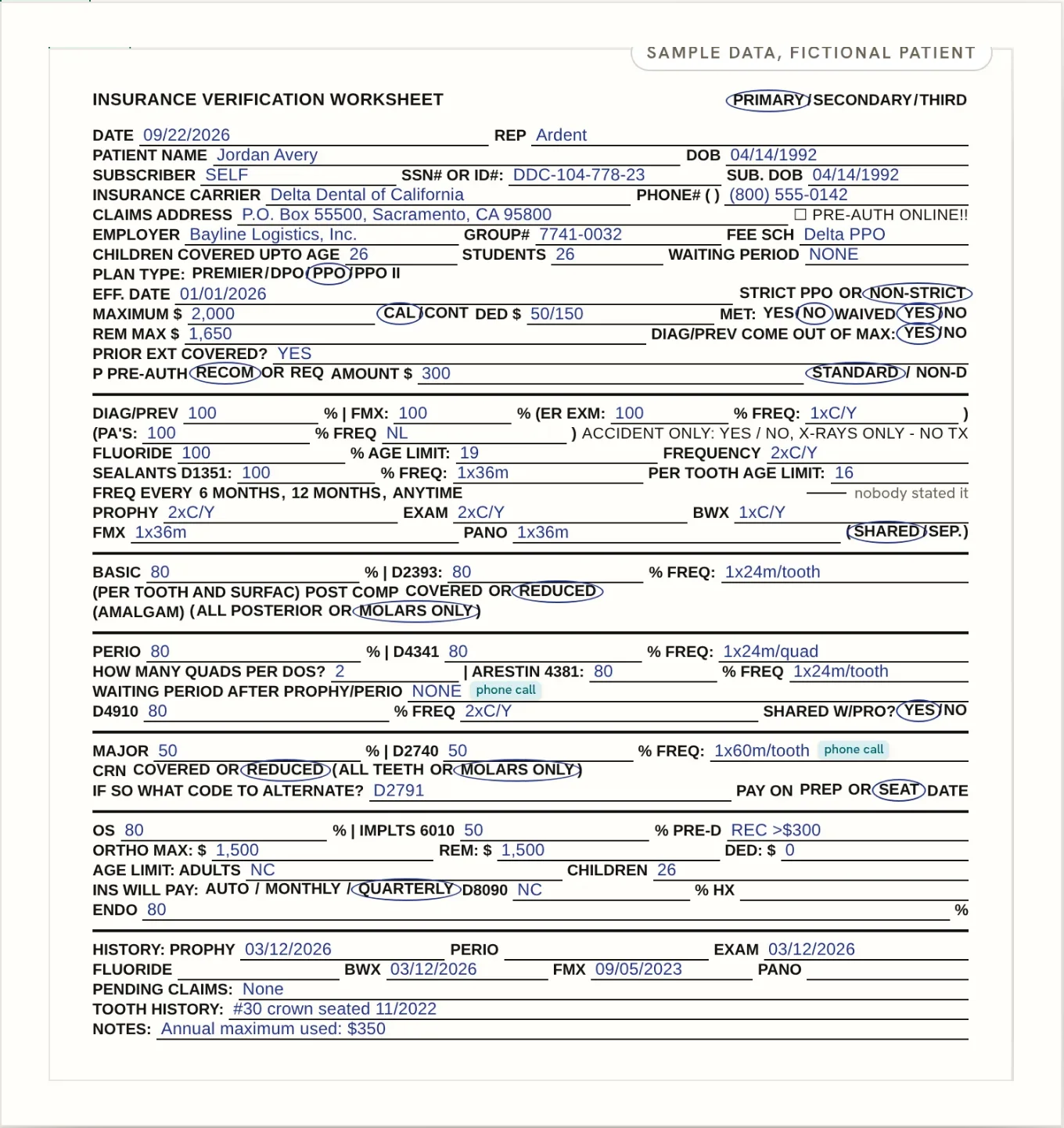
- Source of the values printed in pen-blue
- Portal record from the Delta Dental of California benefits summary, screenshot kept. Every value came from there except the patient’s name, date of birth, member ID and carrier, which are read from the insurance on file in the PMS (Chart), and two answers from a phone call to Delta Dental of California’s provider line, backed by the rep’s recorded words: D2740 frequency 1x60m/tooth and no waiting period after prophy/perio.
Sample data. A fictional patient, condensed for the screen.
Where it goes
Filed in the chart.
The finished sheet lands in the patient’s chart documents as a PDF, with the payer’s own documents and the portal screenshots behind it. Where your system allows a note, Ardent leaves one line on the appointment. Anything it could not verify goes to your front desk in the morning email.
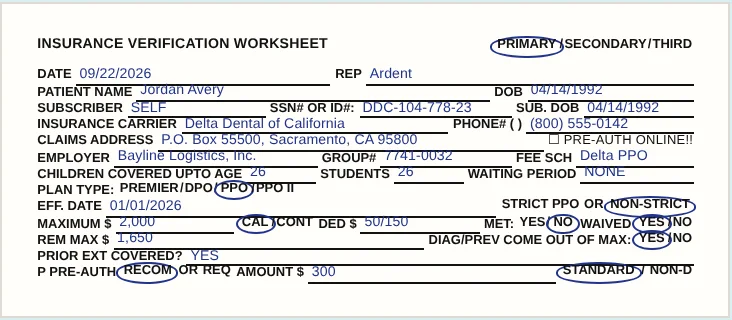
Page 1 of the filed PDF.
3 documents, and a chart keeps every filed check
Ardent adds one line under your own note and rewrites only its own
Ardent could not verify insurance for these appointments at the Northgate office on Tuesday, September 29:
Riley Avery (10:00 AM)Delta Dental of California shows this plan ended 08/31/2026.
All appointments that day: View the full schedule
Every appointment at the Northgate office on Tuesday, September 29 had a successful insurance verification.
All appointments that day: View the full schedule
Weekdays at 7:00 AM, covering tomorrow through the next business day
Integrations
Which practice management systems does Ardent file into?
Ardent works with the practice management system your office already runs. We connect to your schedule, verify the visits coming up, and file the finished sheet as a PDF in the patient’s chart documents.
Works with
Ardent reads the schedule out of the system you already run, and works next week before it arrives.
One page per system: what Ardent reads, what it writes back and how the connection is set up. All practice management systems
Your form
Fills 2,000, 50/150, 100, 80, 2xC/Y, 1x36m, NC in your notation.
We work from the form your office already uses. We measure its blanks once, and after that the answers go straight into them in the shorthand your team already reads: 2xC/Y, 1x36m, NL, NC. If the payer never stated something, that blank stays empty. A general practice, a pediatric office and an orthodontic practice each ask for different things, and nobody at your desk has to learn a new form.
Send us your breakdown form
We’ll show it filled for a fictional patient, in your own labels and notation.
Why Ardent
What makes Ardent different from an eligibility check?
An eligibility check answers whether the patient is covered today. A verification answers the sheet. In most offices a person does that second job, a coordinator or an outside billing service, and that is what we price Ardent against rather than other software. Ardent does the same job as software, filling the fields and attaching the breakdown before the visit.
One patient on next week’s schedule
Jordan Avery, Tue Sep 29, 9:30 AM
Eligibility ping
Active or inactive on the date of service.
Most tools stop hereBenefits read from the payer
Read from the payer’s own portal, or from the fax where that is how the payer answers. Every value keeps its source.
Payer phoned for the blanks still open
Whatever the portal and the fax could not answer is asked on the phone, and every answer is backed by a quote from the rep.
Your sheet filled and filed in the chart
Ardent finishes
- Your sheet
We fill the PDF your office already uses, one blank at a time, in the notation your team writes it in.
- Filed in the PMS
The finished sheet goes into the chart itself, with a note on the appointment where your system allows one, so your team has nothing left to retype.
- Calls for the rest
When the portal leaves a required blank open, we phone the payer and keep the rep’s own words on the recording.
| Capability | ArdentCarries the sheet to the chart | Outsourced verification / VAPeople, on their schedule | Eligibility-only tool (270/271)Answers "active?" and stops | In-house front deskBetween phone calls |
|---|---|---|---|---|
| Who finishes the work | Done, start to finish: Ardent checks the payer, fills your sheet and files it in the chart, unattended. | Partly: Their staff verify; yours usually type the result into the PMS. | Not done: Returns a response; someone still reads and records it. | Partly: Your coordinator, when the phone stops ringing. |
| What you get | Done, start to finish: Your own sheet, filled blank by blank in your notation, as a PDF in the chart. | Partly: Their PDF or fields, in their format. | Not done: Active / inactive, sometimes a few benefit lines. | Partly: Whatever got written down. |
| When it is done | Done, start to finish: Up to two weeks ahead (five business days by default); schedule polled hourly; 6:00 AM weekday run. | Partly: On the vendor’s notice. eAssist asks for at least 2 business days, and a request inside a 3-business-day window bills as two verifications. | Done: In seconds when someone runs it, but shallow. | Partly: Day-of or the night before, when there is time. |
| Payer phoned for what the portal doesn’t show | Done, start to finish: Yes, only for required blanks still open. Up to two calls, every answer quote-backed. | Partly: Sometimes, at their pace. | Not done: No. | Partly: When there is time on hold. |
| A source for every value | Done, start to finish: Portal record and screenshot, 271 rows, fax lines, or the rep’s recorded words. | Partly: A rep name and reference number, usually. | Partly: The 271 itself, for what it contains. | Not done: A sticky note, if that. |
| Blanks the payer wouldn’t state | Done, start to finish: Left blank, and flagged when the blank is required. Never inferred. | Partly: Varies by person. | Not done: Not asked. | Partly: Varies by person. |
| What the front desk still does | Done, start to finish: Reads one 7:00 AM email and fixes what it names: a member ID, a plan that ended, a payer Ardent can’t check yet. | Partly: Sends the list, chases rush cases, re-types results into the PMS. | Not done: Reads the ping, then calls the payer for the rest. | Partly: All of it. |
| What it costs | A flat monthly fee with unlimited verifications, priced against a person rather than per check. Quoted on the demo call. | About $6.50–$8.25 per verification, $12.50+ for rush (Dental ClaimSupport, a vendor blog); eAssist lists $235–$840 per location per month. | Subscription or per-transaction; the phone calls are still yours. | $15.71–$18.26 per hour for an insurance coordinator (Zippia / ZipRecruiter, as cited by Dental ClaimSupport) plus about 12 minutes per manual check (CAQH Index 2024). |
| Sources (vendor / blog figures where labelled): Dental ClaimSupport, eAssist pricing and service page, CAQH Index 2024. | ||||
Scroll →
Done, start to finishPartly: someone at the practice still finishes itNot done
Is outsourcing verification cheaper than software?
Outsourcing scales without payroll but costs roughly $6.50–$12.50 per check (Dental ClaimSupport, a vendor blog), typically wants at least two business days’ notice (eAssist), can be blocked by payer-portal geo-fencing, and usually leaves staff typing results into the PMS. Ardent charges a flat monthly fee rather than a price per check, runs unattended against every appointment on the schedule, and files the finished sheet into the chart itself. A plan it has no playbook for yet is named in the morning email rather than left silently blank.
Pricing
A flat fee. Unlimited verifications.
We charge one flat monthly fee for the practice, and it covers every verification Ardent runs. There is no per-verification charge and nothing extra for a rush. If you run more than one location, use a sheet of your own, or have a season that runs heavier than the rest of the year, we work the terms around that. We quote the fee on the demo call.
- Outsourced service $6.50–$8.25$12.50+ for a rush
- In-house coordinator $6.52in staff time, per manual check
- Ardent Flat monthly feeunlimited verifications, no rush charge
At our benchmark of 500 verifications a month, that works out about 70% less per verification than paying by the check. We quote the fee on the demo call.
Per-check figures: Dental ClaimSupport, a vendor blog. Staff-time figure: CAQH Index 2024, where “manual” means phone, fax, email or mail.
- Unlimited verifications under one flat fee
- Per practice, with multi-location plans
- No per-verification or rush charges
Answers
Frequently asked questions.
Confirming, before an appointment, that a patient’s plan is active and documenting what it covers: annual maximum and remaining benefits, deductible, coverage percentages by category, frequency limits, waiting periods, missing-tooth and downgrade clauses, and pre-authorization rules. Offices do it by payer portal, phone, fax or an electronic 270/271 eligibility transaction. Read the guide to dental insurance verification.
Eligibility answers yes or no on whether the patient is covered on the date of service. Verification (a benefits breakdown) records the plan’s limits and rules so the office can estimate the patient’s share. A 270/271 often answers only the first question; dental offices still use portals and phone calls for the rest (CAQH Index 2023; Open Dental manual).
Each payer has a playbook: the provider portal first (a deterministic field map reads the portal’s own data), or an EDI 270/271 inquiry or an IVR-requested faxback where that is the payer’s channel. Whatever required blanks are still open, an AI voice agent phones the payer’s provider line during its business hours, up to two calls, and each answer must be backed by a quote from the rep.
Yes. Ardent stores your sheet’s PDF and draws the answers onto it, blank by blank, in your notation. Two practice sheets are in production today: a general worksheet and a pediatric breakdown. A new sheet is set up by measuring its blanks once.
Ardent fills 99.8% of sheet fields accurately. Every printed value carries its source: a portal record and screenshot, the 271 rows, the fax lines, or the rep’s recorded words. A blank nobody stated stays blank; NC prints only for a stated exclusion. Results are informational; your office confirms coverage with the payer.
The next channel in that payer’s playbook runs only for what is still open, ending with a phone call to the payer. If a required blank is still empty afterwards, the sheet leaves it blank, the appointment is flagged "Someone has to call," and it appears in the 7:00 AM email to the front desk.
One weekday email covering tomorrow through the next business day. It lists each appointment Ardent could not verify, with the reason in plain words: a member ID missing, a plan the payer says has ended, a payer Ardent cannot check yet, a response without enough dental benefit information. On a clean day it is one line saying every appointment had a successful verification.
It runs on its own. The schedule is polled hourly and a 6:00 AM weekday run verifies visits up to two weeks out, five business days by default; failures that will clear on their own retry after 6 and 48 hours. Your team can also run or re-run a verification for any appointment on demand, or check a patient who is not on the schedule.
Early enough to fix inactive coverage or missing details, late enough that benefits used are current. Ardent’s unattended jobs reach up to two weeks ahead, five business days by default: the schedule is polled hourly and a 6:00 AM weekday run verifies visits entering the window; a successful check within 30 days of the appointment date is reused. The window is a per-practice setting, set to whatever lead time your office wants.
Dentrix, Dentrix Ascend, Dentrix Enterprise, Eaglesoft, Open Dental, Curve Dental, Denticon, Cloud 9 and OrthoTrac through the NexHealth Synchronizer, and CareStack directly. In use today on Eaglesoft (Randhawa Dentistry, through NexHealth) and CareStack (Montclair Pediatric Dentistry). See the integrations pages for what Ardent reads and writes on each system.
The completed sheet as a PDF in the patient’s chart documents (named insurance-eligibility-<first>-<last>.pdf). On Dentrix, Dentrix Enterprise, Eaglesoft and Open Dental, a one-line appointment note when something on file needs fixing. On CareStack, a coverage summary with an estimated copay on the appointment’s Status & Notes and Patient Memo. Ardent does not overwrite coverage-table fields.
No. Ardent removes the portal logins, hold time and worksheet typing. Your coordinator handles the exceptions Ardent flags: details to fix on file, plans Ardent cannot check yet, blanks a payer would not state. They also explain estimates to patients and manage pre-authorizations.
Ardent operates payer-specific playbooks for 71 payers, including 42 Delta Dental member companies, MetLife, Cigna, Aetna, Guardian, UnitedHealthcare Dental, United Concordia, Principal, Ameritas, GEHA, Beam, Humana, Anthem, several Blue Cross Blue Shield dental plans, FEDVIP plans and Medi-Cal Dental. A plan Ardent cannot check yet is named as such in the morning email. See the payers Ardent verifies.
A plan provision excluding coverage for replacing a tooth lost before the patient’s coverage began. Verify it before treatment-planning bridges, implants or partials. On the general worksheet the printed question is "PRIOR EXT COVERED?", which Ardent answers YES or NO only when the payer states it.
Yes, for portal automation. Credentials live only for the duration of the call that needs them and never enter a model, a log line or a response; every portal request is limited to that payer’s domain; emailed one-time codes are read from a mailbox you designate; Ardent never solves CAPTCHAs. Payers without a portal are worked by EDI, fax or phone.
Connect the PMS (NexHealth’s Synchronizer on your server or its Chrome extension for cloud PMSs, where NexHealth says to allow up to 72 business hours; for CareStack, a dedicated login you create), share payer portal credentials, choose your sheet, then Ardent switches on polling, ahead-of-visit verification, filing and the digest one at a time after a supervised first run.
Ardent operates as a HIPAA Business Associate and signs a Business Associate Agreement (BAA) with every practice. Every subprocessor that handles protected health information does so under a BAA, and AI extraction and the voice model run on a zero-retention endpoint. Data is encrypted in transit (TLS) and at rest, access is least-privilege, PHI access is audit-logged and PHI is excluded from application logs. Payer calls are recorded with a disclosure on the call. Details are in the Privacy Policy. More on the security page.
Outsourced verification runs about $6.50–$8.25 per check and $12.50 or more for a rush (Dental ClaimSupport, a vendor blog); eAssist lists $235–$840 per location per month. Done in-house, a manual check takes about 12 minutes of staff time (CAQH Index 2024), roughly $6.52 at an insurance coordinator’s $15.71–$18.26 hourly wage. Ardent charges one flat monthly fee per practice with unlimited verifications and no rush charge; at a benchmark of 500 verifications a month that is about 70% less per verification than paying by the check. The fee is quoted on the demo call. The full comparison, with sources.
A benefits breakdown, also called a breakdown of benefits, benefit breakdown form or insurance verification worksheet, is the sheet a practice fills in for each insured patient before the visit. It records the plan’s annual maximum and remaining benefit, deductible, coverage percentages by category (preventive, basic, major, orthodontic), frequency and age limits, waiting periods, missing tooth and downgrade clauses, and pre-authorization rules, so the office can estimate the patient’s share. Ardent fills the practice’s own breakdown form, blank by blank, rather than replacing it with a new one.
The 270/271 is the HIPAA-standard electronic eligibility inquiry (270) and response (271) that a practice or its clearinghouse sends to a payer. It confirms whether coverage is active on the date of service and sometimes returns a few benefit lines, but it rarely answers a full breakdown: frequency limits, waiting periods, downgrade and missing tooth clauses usually still need the payer’s portal or a phone call (CAQH Index 2023; Open Dental manual). Ardent uses the 270/271 where it is a payer’s channel and works the portal, the fax line and the phone for the rest.
Yes. Ardent operates playbooks for 42 Delta Dental member companies, including Delta Dental of California. It signs into the Delta Dental provider portal with the practice’s credentials, reads the benefit grid field by field, keeps the portal record and screenshots as the source, and phones the provider line only for required blanks the portal leaves open, with each answer backed by a quote from the rep. How Ardent verifies Delta Dental plans.
Yes. Ardent fills whatever sheet the office already uses. A general worksheet and a pediatric breakdown are in production today; a pediatric sheet asks for age limits, which teeth a sealant covers and codes a general sheet never lists, and an orthodontic sheet asks for a lifetime maximum, a banding date and a payment schedule. A new sheet is set up by measuring its blanks once. Ardent connects to Cloud 9 and OrthoTrac through the NexHealth Synchronizer, and Montclair Pediatric Dentistry in Oakland runs it on CareStack. See the Cloud 9 and OrthoTrac pages.
Ardent is in use at dental practices in the San Francisco Bay Area: Randhawa Dentistry (Emeryville and Alameda, on Eaglesoft), Montclair Pediatric Dentistry (Oakland, on CareStack), Chestnut Square Dental (Concord), Crossroads Dental Care (Vallejo) and Pinole Hills Dental (Pinole). Ardent serves dental practices anywhere in the United States; the payer playbooks and practice management system integrations are not tied to a region.